“I would like to share this effort from Sala d’Arme dell’Appeso at retrieving fencing fundamentals (timing, distance, footwork) from two manuscripts belonging to Liechtenauer’s tradition. Thanks to Davide Morleo, Francesco Viola and Federico Dall’Olio for months of trial and discusssion (and costant spam and delirium by my side about olympic korean sabreaurs). Thanks to Maciej Talaga too for his kind and crucial feedback and contribute.(I remade the post since last one didn’t seem to work)“
Sword in one hand has four guards(ish), though most people view it as only one. The guards are:
High on the right, depicted here as something like Donna, or it could be something closer to Fenestra as the end point of a roverso sottano (rising backhand cut) or the preparation for an imbroccata (a thrust that descends on the line of mandritto). I would say Donna and Fenestra for simplicity.
A point forward low guard on the right, depicted here with hand withdrawn slightly, for the purpose of throwing a thrust or punta. I would call it Coda Longa Alta, just to stick with later nomenclature for this position.
Coda Longa on the left side, shown here backweighted, also called the deflecting guard. Using later nomenclature, you could also call it a variant of Porta di Ferro Larga, or Guardia Sotto il Bracchio (underarm guard)
From right Donna, cut a dritto fendente down into Coda Longa on a right pass in, cut a roverso sottano up into Fenestra on a left pass in, thrust an overhand thrust that withdraws immediately into Coda Longa Alta, thrust an underhand thrust advancing the right foot and a full step back with a roverso fendente that circles up onto your shoulder in right Donna again.
Donna can beat, cover, break, exchange, and with a cut first to bind on, can turn a villano.
Fenestra can easily cover, break, and exchange, or with the same bind villano.
Coda Longa Alta is can beat, cover, and exchange easily, but doesn’t have the same facility to break. With an attempt to exchange as the way to bind on, you can then villano.
Coda Longa as depicted on the right, can beat, cover, break, and villano easily, but has difficulty exchanging the thrust.
This simple schema of sword on the right and left in 2-4 guard schemas appears in Fiore, Talhoffer, Viggiani & Capoferro & Dall’Agocchie’s simple duel preparation, Pietro Monte, and Marc’Antonio Pagano’s sword in one hand, suggesting that it’s a well known, simple, and effective schema for intense and varied fighting. I’m going to get deeper into Pagano and Monte this next week or two to really play with the concepts. Sword in one hand proved to be an effective and high percentage strategy for closing to Stretto at Boar’s Tooth.
Also worth noting that porta di ferro mezzana is transitioned through in the sword in 1 hand version of the rompere (remember armizare is all about moving from guard to guard) and posta di donna la sinestra & dente di cenghiaro in one hand show up as well, albeit on horseback. Also i would call the withdrawn thrusting position breve rather than coda lunga alta as it fits with fiore’s guard naming conventions better (if this were bolognese i would otherwise agree with you)
Agreed, especially with the point about horseback convention. That’s absolutely Breve. Donna, Breve, and Coda Longa (deflecting guard). Including the sword in one hand on horseback, we would have to add Donna La Sinestra and Dente di Cenghiaro, as you note, and that’s much more rounded.
I’m going to keep playing with this, but making the assumption that Fiore was aware of a distance measure that fits with the circular segno is probably fair (since the Italians claim later that the segno is ancient). From there, it’s a matter of fitting footwork, the Five Elements (beat, cover, break, exchange, villano), and the specific plays that fit from the system as a whole.
I designed a sword and Pavel Moc executed it extremely well and close to my specifications. It has an 86 centimetre blade, with a point of balance about 4cm from the cross. It weighs 1.6 kilograms.
For a while now I have had the opinion that it doesn’t make much sense to “Do Liechtenauer” with a sword that you can’t put to good use in just one hand. I have various proofs in the work for this theory, and this is another step of the way there.
It can crush binds but has godly point mobility even in one hand. It’s pretty much exactly what I was hoping for. Tomorrow I will put it to a bit more use.
Aaaaw man, am I into this. One of my big problems with HEMA generally is the focus on blossfechten as a main thing we’re doing, separated from a historical context. The whole “hey, we’re training for an unarmored duel” is largely nonsense, because the culture where unarmored duels became normal is a 16th century innovation. In the Medieval period, it was extraordinary that Fiore dei Liberi, a man who was a travelling master at arms, fought five times with only a gambeson and leather gloves.
His noting that is to tell us what an amazing badass he is, because fighting without armor is insane. Lichtenauer’s art is great and all, but I’m increasingly dissuaded from viewing it as a) common and relevant (which we know it wasn’t, it was intentionally hidden) and b) efficacious in the Medieval context. Outside of peasant scraps and crime, most combat was conducted wearing armor, and for the people with training in the era, most of that was done where the combat began on horseback. Even in tournament, you were completely armored, and injury rarely resulted. Armor and training was a significant part of what maintained feudal power, I guess, is what I’m getting at, and the blossfechten concept is either ahistorical and a result of misinterpretation, or a particular development from folks who loved the art in the period, and not incredibly relevant to what actual Medieval people did as SOP in combat.
“You don’t rise to the occasion, you sink to the level of your training.”
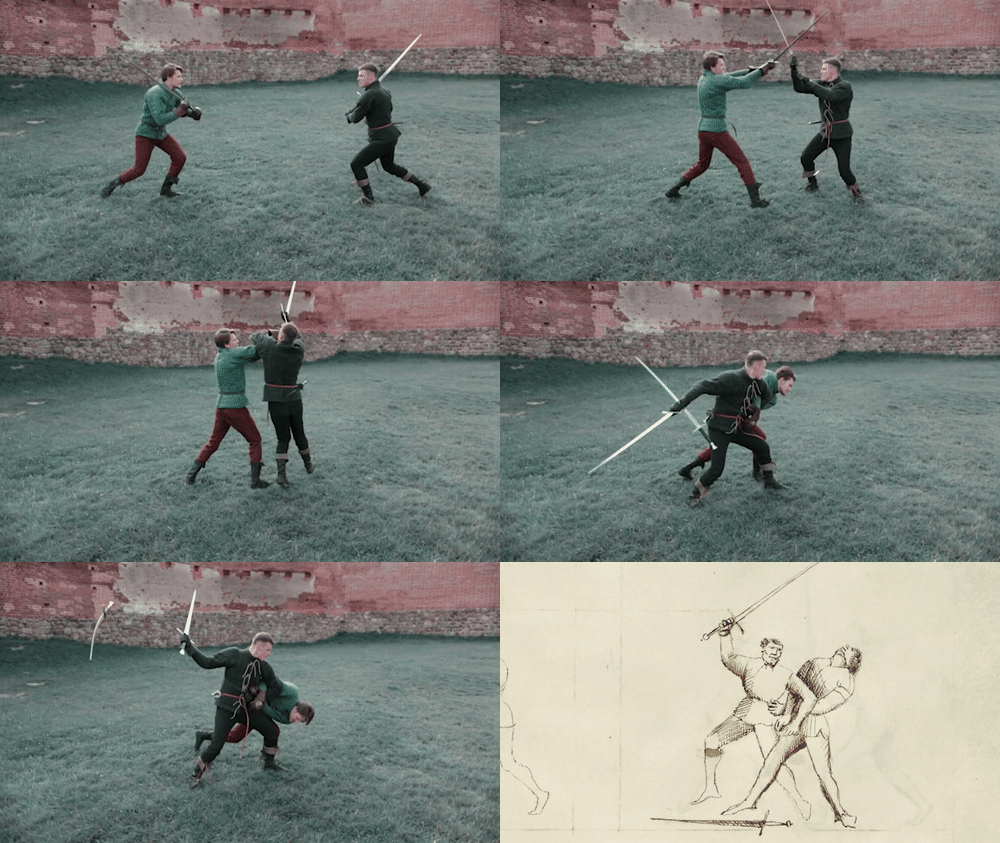
Train the way you fight, fight the way you train. Above is a demonstration to a class, below the application during a bout.
Ilkka and Hannu Hartikainen demonstrating, Ilkka Hartikainen and Axel Petterson fencing.
hema gasm
Oh cool! I actually just practiced this this week! It’s a really fun technique.
This is feinting.
Often when people think of a “feint” they imagine someone jerking one way then suddenly changing direction to fake out their opponent. That does happen sometimes but it’s slow, wastes energy, and it’s not something a trained fighter is likely to do unless they’re attempting the equivalent of yelling “boo!” with a sword.
In this the attacker makes a diagonal, downward strike and nearly completes the attack, drawing the opponent’s bladeto defend against what appears to be a clear strike towards the head, but before the defender’s parry can make contact, the attacker turns their wrist to redirect the energy of the swing to go around and continue at the now open space on the other side of the target’s head.
A good feint will look like a regular attack until the moment it changes directions.
In this case the attacker is using two feints, one on each side, before hitting his target.
Variations include a feint that comes over the defender’s sword to attack on the same side as the original swing. Feints can rely on ‘training’ your opponent to expect or not expect the move by creating a pattern in your attack, then breaking it. Sometimes feints can be dangerous if your opponent tries to counter attack instead of preparing to block again, which is why you may want to judge your opponent’s likely reactions first.
One of the fun things about practicing this, was that when I was the target and the feint was done well, even though I knew what the drill was and knew it was going to happen, I still felt robbed and swindled every time the attacker’s blade danced away from my scripted parry to come around and hit me in the mask.
What makes a sword a sword? Is it its shape? No, this can’t be, because sword shapes – cruciform, crescent, etc – lengths, and styles vary greatly, by both time and space. Is it based on lack of projectiles? Maces, clubs, axes, and spears don’t shoot projectiles, but no one would call them a sword. What does a 17th century rapier have in common with a Roman gladius? What does an Iberian montante have in common with the arming sword featured in the I.33 manuscript?
What do they all have in common? Swords, quite simply are long, bladed weapons, often (though not always) with a point, designed to kill. There are a few ways swords can do this in the hands of their wielders, but the two most common ways are via cutting – using the sword to hew – and thrusting. The medieval longsword, used in Europe from about 1300-1500, has the best of both worlds in that it is a weapon designed to be able to both optimally cut and thrust an opponent.
In Cutting with the Medieval Sword, Mike Edelson pulls off the remarkable feat of getting at the very heart of what makes using a sword an art (as opposed to a sport), and does so in a way that is accessible to everyone – from those who have never picked up a sword in their life, to practitioners with years of experience.
Make no mistake – this is not a book for sport fencers; this is a book for those who wish to start or continue learning how to use a sword as it was used historically and martially – to maim or kill your opponent.
Assuming that your interest in HEMA and swordsmanship is at least partly martial, however, you will find this book an invaluable resource. The information is presented in a straight-forward, easy-to-understand manner, with copious illustrations and analogies that can be absorbed by everyone – even me, and I’m a notoriously slow learner when it comes to swords. There’s no need to be familiar with middle-high German, Italian, or Latin; when excerpts from manuals are included here, they have been translated (via the wonderfully talented Cory Winslow).
***
The book is divided into theoretical, practice, and calibration sections, which I will address individually:
Theoretical — This part can (and perhaps should) be a textbook used in all HEMA classes. It addresses all the concepts one should know when it comes to cutting with a sword (and there’s also a bit about thrusting, as well), and the appropriate body mechanics to make it work. Although the section is intended as a reference and does not have to be read chronologically, I’d still recommend everyone read it and then, for newer students especially, come back to it as terms and ideas become more familiar.
Personally, I was surprised to lear about the importance of regulating one’s breathing – I don’t usually remember to breathe when fencing or cutting, but here Edelson has explained in detail why exhaling with the strike is extremely important.
In fact, with all concepts here, Edelson has found a way to explain not just why a certain concept is important, but how it relates to cutting as a whole – for example things such as grip and stopping the sword may seem to be minor details, but a poor grip or inability to stop the sword at the appropriate point can be the difference between a successful and unsuccessful cut.
Practice — Contrary to popular belief, you don’t need a sharp sword to practice (although you certainly can), but a blunt or feder capable of producing good sword wind can often get the job done – details as to how to choose a good blunt are in the text. Cutting practice doesn’t refer to cutting tatami or water bottles (that’s calibration), but to the thousands and thousands of cuts one should practice in the air at home. The tl;dr here is that you want to make sure you’re training to cut through your target, and if you only ever practice against a calibration medium, you’ll just train yourself to cut and only cut that medium.
There are a wealth of drills in the practice section, many familiar to me as I train with the NYC branch of Edelson’s club, but some entirely new, and they are divided into foundational and core drills. Foundational drills are designed to get you the basic movements and skill sets; core drills further refine these and should become a regular part of your practice. Some the drills need a partner, but may can be performed solo, and some need only a wooden dowel to be performed.
Those new to HEMA or longsword instruction will likely find many of these drills helpful to do with their class, adjusting as appropriate to the experience level of their students.
Calibration – This is the section that deals with sharps and feedback materials.
First, Edelson goes into detail as to how to choose an appropriate sharp sword for one’s size – personally, I use an Albion Count and have just received an Albion Crecy – as well as what manufacturers to choose from. The adage “you get what you pay for” is especially true here; your Renaissance fair wall hanger is probably not going to get the job done.
Edelson then goes on to describe how to properly sharpen your sword; although instructional videos exist (the links are provided), this is an activity that should absolutely be done under supervision for newer students, and practice on kitchen knives or other swords you don’t care about first is recommended. That said, more experienced students will delight in the interview with Peter Johnsson provided here, which was a pleasant surprise for myself.
As for feedback materials, tatami is the best material currently available for test cutting based on factors of cost, weight, and diagnostic ability (ie, the ability to understand what you did right or wrong when you cut it). Edelson also addresses the positives and negatives of cutting clay, water bottles, pool noodles, and newspapers – tl;dr, if you can’t get tatami, clay is probably your next best cutting medium but there are some serious drawbacks.
Edelson goes into great detail explaining how to prepare tatami, including where to order it, what tatami to get (new vs old), how to roll and soak it, and what your cutting stand should look like. For newer students, learning how to spike tatami is also an important skill – mats spiked incorrectly can be artificially hard to cut. This is followed by suggestion patterns and diagnostics, so that you will be able to see what you did wrong.
This ends with a section on cleaning and repairing your sword; the short version is that except for routine cleaning and the most superficial nicks, repairs should be handled by professionals – which is one reason vendors such as Albion are so highly rated, as they provide this service.
***
While many of us participate in the competitive side of HEMA as a sport, it behoves us to always remember that ultimately what we are studying is a martial art. As a community, we have come a long way in the last ten years – from having a surfeit of feders and sharps to choose from, to having multiple vendors offering HEMA-specific protective gear – and this book should be included in the lexicon of game-changers.
HEMA is awash in primary sources, which is amazing, but there has been a gap in texts concerned with cutting, as opposed to set plays and techniques, and appropriate sword care. This fills that gap, and should be a recommended text for those in the community for years to come.
Cutting with the Medieval Sword goes on sale Tuesday 21 November.




 Aliquid de Magis