Some sample pages from Andrew Loomis’s series on how to draw comics, 1939-1961, concerning perspective and composition. (The changes in font and layout stem from the fact the pages come from different prints.)
I tried to collect the most useful pages, but of course I’m limited to only 10 images per post.
This is a follow-up of sorts of the Disney “how to draw comics” handouts I posted earlier, and which can be found HERE.
I kept wanting to add more and more stuff to this but realised it was meant to be a short crash course intro to some sources, so here you go. A rundown of the major sources of information we have on Johannes Liechtenauer.
Consider this like a really basic road-map to sources if you decide to crack one open. It’ll show you roughly where you’re at and where you might want to go next.
Needless to say there is much, much more to it than this. But it could get you started.
So You Want to Name a Sino: A Guide to Not Making a Fucking Fool of Yourself
Note: this will be long and very, very extensive because god I am so sick of this shit 2k16 I just want absolution and I don’t think that’s too much to ask, and even if it is I’m asking it, I’m not asking it emptyhanded I’m asking it with a WHOLE GUIDE FOR YOUR PERUSAL, because I’ve found that Wiki’s great if you want to know why and how we use names and not really great for when you actually want a name.
A theme of this blog seems to be my long suffering, and I want it known, recorded, carved in stone that as of almost 1:00AM on Thursday, December 22nd, 2016, I am officially Fed Up with the way Sino characters are named in fiction.
Let us be clear: this is first and foremost An Attack™* on all the white authors whose imaginations can only extend so far to provide us with a glut of Lings and Linglings and Ailings (not that those aren’t beautiful names) and Peonies and Pearls and, god forbid they start getting creative with their Sachas and their Wai-maes, but this is also for the Sino authors who can’t seem to do it either. And like, I get it. It’s not easy. Sinos are a disparate bunch with varying degrees of fluency in varying dialects of Chinese. Romanisation and naming customs are weird.
But also can we leave the idea of the inscrutable mysterious unknowable East in the 20th century please? There are resources. This is one of them. Let’s start before I steep for too long in my own bitterness and annoyance.
In a couple of sources, there is a bit of sword-anatomy referred to as the “window” or “little window.” This part was known to the old fencers as a tactically significant part of the weapon, at least enough to write techniques about.
It’s referred to specifically for use in two quite different techniques. The first one is in HS3227a.
zo haw eyn öberhaw gleich czu ym / alzo das du dynen ort schüst / ym czu seyner linken seiten öber dem gehilcze yn / alzo das du das selbe löchel vnd fensterleyn / io gerade treffest / czwischen der sneide~ vnd deme gehilcze / triftz du / zo hastu / gesigt /
So cut an oberhau likewise against him, casting your point out to his left side over the hilt, and aim to arrive right at the little opening or window between the edge and the hilt. If you meet him here, you’ve won.
This opening has been noted by modern fencers as a weakness to the thrust. I can’t say for sure why the old fencers valued it, but for me, it’s good because the opponent has a habit of guiding our point into their body with the hilt, if we engage their blade in such a position. A lot of the winding plays in the Liechtenauer glosses would seem to make use of this position. It’s also the part of the sword closest to their body in a parry (unless they’re holding the thing backwards or whatever, can’t rule anything out), so your chances of circumventing a parry through it are higher than anywhere else on the blade.
Second does not describe the “anatomy” of the sword-bit, but the name is the same and the use makes it pretty clear, in Hundsfeld:
Item gee auf mit dem knopf vnd vor setz mit dem venster vnd greif in das halbswert vnd wechsel die hinder hant foren vnd slach ÿm zu dem hals ~
Next, go up with the pommel and parry with the window. Grasp in the half-sword and switch the rear hand forward, then strike the opponent to the neck.
A pretty Chadly maneuver actually: Pommel moves up with the point hanging down, and we take hold of the blade. We are told to parry with the window. Why? My guess is to catch the opponent’s parry and lock it in our sword rather than let it slide off (and through our hand) as with a colpo di vilano or so-called Hildebrand’s cut. Then we pull the rear hand (that on the grip) forward (on the sword) and make a mordhau or hook and throw with the hilt.
Martin Siber left us a line:
Sichstus venster offen stan Si hinein gee dar von
If the window lays open Go in from there
Which is alluded to by Leckuchner as well in a play from the Bastei. Whether this is the same Fenster, who knows. It’s of course possible that this refers to a general opening.
Lastly the one everyone should know is sprechfenster/brechfenster. I’m going to completely refrain from providing any theories about a connection to those techniques. You can figure it out.
I find thrusting in through the short edge window particularly effective – when people try to parry it, they often carry their point offline without moving the hilt aside, leaving the precise opening my attack is entering through. Durchwechseln into this opening (as indicated in 3227a) is a great way to attack someone in longpoint.
Here’s two of my students from a few months ago. Note where the blade is passing.
here’s an old patreon reward to fill in the drawing-hiatus void a bit; something I get asked about a lot is the ‘acting’ in my comics and how to be subtle with conveying emotions. The answer is mostly experience and constantly observing people in real life to learn about expressions, but knowing when to ‘dial up’ or ‘dial down’ emotion is very important! context is king- this is basically the same advice that Carl Barks gave on one of his reference sheets here (in a much more succinct manner!):
I like that he even uses the Fiorean terminology “cover”. Blocking leaves you at range, counterstriking and covering through your entry is about getting to safety and making the other person regret striking at you. Modern police tactics, especially when they align with the wrestling and dagger work we see in the historical books, is a great source material for reconstruction, in my opinion.
This is also a good wrestling drill. Establish the set up of the 1st Play of the Abrazare with arm control and head blocking, the other person vies to put you in the same position. One minute rounds or something, rest, re-engage.
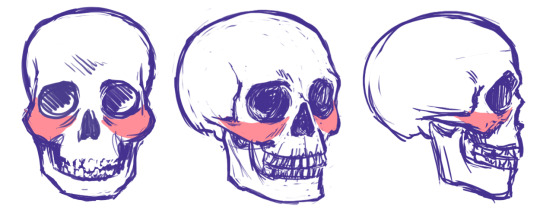
I’ve found that drawing the head starts to make a lot more sense once you start thinking about cheekbones and cheeks, and how the fit into the head structure.
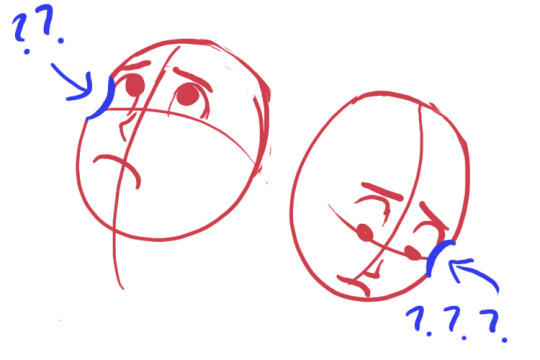
You might be aware of the Mysterious Indent that Looks Good Next to the Outer Part of the Eye, or the Mystery Indent for short.
Drawing a Mystery Indent may serve you fine if you only draw the head from flat angles, but it falls apart when you get adventurous.
Why isn’t this making sense anymore?
Drawing a ‘Mystery Indent’ is an attempt to imply cheekbones without knowing how they actually incorporate into the skull, and this is why it looks so unconvincing when you use it to draw the head in anything other than ¾ view.
The cheekbones wrap around the head and eye sockets from above the bridge of the nose. The concave you draw if you draw the ‘Mystery Indent’ is a misunderstanding. There is no concave. You should instead be thinking of this as where the eye socket/brow overlaps the (convex!) cheekbone.
Compare the cheekbones on both sides for placement. They should match up and correspond with each other.
(Knowing cheekbone structure helps when drawing gaunt characters, because their cheekbones may stick out. Remember to compare the cheekbone placement on both sides!)
* This is part of a much larger tutorial I’m working on about head, face, and facial feature structure. Hopefully more to come eventually?





 Aliquid de Magis