This is on of my absolute favorite tutorials, and I can’t believe I haven’t posted this yet… I’ve used this method hundreds of times (okay, maybe 3-4), but it works flawlessly every time.
This method creates beautiful armor pieces on the cheap, but they still look amazing. This is one of those cosplay-life-changers!
Check out the full tutorial here
THIS IS THE TUTORIAL THAT TAUGHT ME HOW TO MAKE CRAFT FOAM ARMOR.
Tag: reference
As requested, a tutorial on how I approach lips. This is just how I see them, but I hope it helps!

M1897 Trench Gun.
This shotgun saw brutal use in the trenches of World War I. American raiders would drop in, and turning rapidly, blast down both directions of the trench axis.
Other than that historical tidbit…it’s a SHOTGUN…with a f*king SWORD on it…I am now seized by an uncontrollable urge to put a 16” bayonet on every one of my longarms…
how fascinating. i mean, it makes perfect sense, but i’ve never heard of such a thing before in historical literature or military fiction. perhaps i’ve just been reading the wrong things.

this reminds me of a nature documentary. you know the ones that show the predator pouncing in slow motion. (in other words, all of them)
Faldbúningur 18th Century
Faldbúningur is the oldest form of Icelandic folk costume, and had gone out of use by around 1850, but has been to some extent revived today. It was also the starting point for most of the other forms. It is characterized by a large white headpiece that curves forward. This was called the krókfaldur.In the mid to latter 18th cent, the high headdress began to be replaced by a stocking cap with a large tube and tassel (tail cap), which was adapted from the men’s costume. | Sources: [x] [x] [x]
Icelandic Folk costumes a request by: Sweet Holy Potato
All hail the matriarch (◡‿◡✿)
COOOOOL

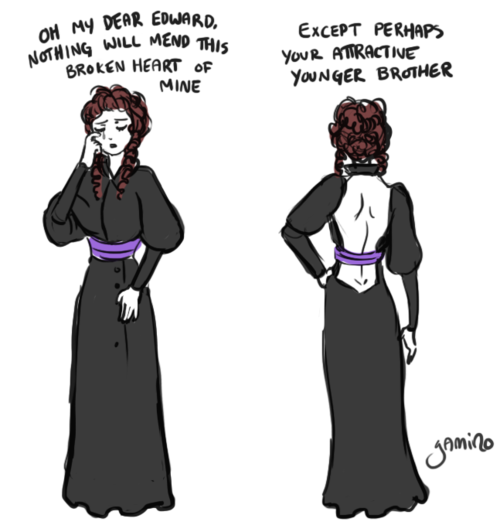
Half-Mourning Dress
1910-1912
The Victoria & Albert Museum
What’s a “half-mourning” dress? Mourning in the front, party in the back?
Half-Mourning was the third stage of mourning for a widow. She would be expected to mourn her husband for at least two years, the stages being Full Mourning, Second Mourning and Half-Mourning. The different stages regulated what they would be wearing, with Full Mourning being all black and with no ornamentation, including the wodow’s veil, and the stages after that introducing some jewellery and modest ornamentation. When in Half-Mourning you would gradually include fabrics in other colors and sort of ease your way out of mourning.
Wow, I am happy you made that joke so I could interpert it as a serious question and have an excuse to ramble on about clothing customs of the past, I am a historical fashion nerd.
That’s very informative, but I’m going to stick with my original head canon:
I love both the informed fashion history and the hilariously off-the-wall halves of this post.
Partizans
Photo #1
- Attributed to Jean Berain I (1640 – 1711)
- Dated: circa 1670 – 1680
- Culture: French
- Medium: steel, gold and velvet, etched, chiselled and gilded
- Measurements: blade length: 53.2 cm, straps length: 7.3 cm. Weight: 1.92 kg
- Inscription: ‘NEC PLVRIBVS IM·PAR’
Photo #2
- Dated: 1719
- Culture: Polish
- Medium: steel, oak, copper alloy, gold, velvet and silk, stippled and gilded
- Measurements: overall length (including socket): 62.2 cm, straps length: 45.7 cm. Weight: 2.69 kg
Photo #3
- Dated: 1714
- Culture: French
- Medium: steel, silver and pine, damascened and engraved
- Measurements: overall length: 184 cm. Head length: 32 cm. Weight: 1.3 kg
Photo #4
- Dated: 1620
- Culture: French
- Medium: steel, gold, copper alloy, silk, velvet and cotton, blued and damascened
- Measurements: overall length: 222 cm. Head length: 53.3 cm. Weight: 3.104 kg
- Inscription: ‘L’ With collars of the Orders of St Michel and the Saint-Esprit
Photo #5
- Designer: probably Georges Berain
- Dated: 1662 – 1715
- Culture: French
- Medium: steel, gold, silk, wood, silver, copper alloy and velvet, chiselled, blued and damascened
- Measurements: overall length: 240 cm. Head length: 53.3 cm. Weight: 2.91 kg
- Inscription: ‘NEC PLURIBUS IMPAR’ ‘Equal to anything’
Photo #6
- Dated: 1640
- Culture: German
- Medium: steel, copper alloy, gold and oak, etched and gilded
- Measurements: hear length: 61 cm (including socket). Straps length: 47.6 cm. Weight: 3.48 kg
- Heraldry: 3 lances, the banner charges with crosses patty; supported by cranes holding also the mitre, sword and episcopal staff
- Inscription: ‘IN · HOC · SIGNO’
- Decoration: Arms (three keys, 2 and 1; supporters; two cranes, each holding a key)
- Inscription: ‘·POUR · BIEN ·’d
First off: I’m a girl in there! It’s hard to tell, but I promise I am!
Here’s the newest set of photos of my Warhammer 40k tech-priest cosplay! These are all from Youmacon 2013. I’ve added a bunch of new things to this version. The backpack in new, the robe is new, a bunch of new electronics including a flickering blue power source in my pack, tons more purity seals, and some major updates to my servoskull, Toby.
This costume has won 6 awards: Judge’s Choice (Animarathon 2013), Hall Cosplay Award (Ohayocon 2013), Best In Show (A&G Ohio 2013), 2nd place in Sci-Fi Division (Origins Game Far 2013), Best in Show (Packrat Comic’s Not at Comic Con Comic Con), and Best Master Class (Midoricon 2013). And at Origins, I recieved a standing ovation from the Games Workshop booth. At Youmacon, I ended up meeting a couple who used me as the inspiration for their tech-priest. It was such a huge honor!
Next appearance is probably Ohayocon 2013 on Saturday. There might be something between here and there, but that’s the next planned one. If you’d like to see me, let me know!
The other tech-priest you see in a few pics is a guy I met at the con who used all the photos of me as inspiration for his costume. It was a pretty cool honor to run around with him most of the day on Saturday!