SFF worldbuilding has as many layers as the characters w/in it. You can’t sacrifice one for the other. It’s easy to duplicate a world that’s familiar in landscape &society, but coming up w/something original&immersive is another art altogether.
Start with broad location. On Earth? Not on Earth? Space station? What kind of age? Does your story require a city? A mountain? A forest? A river? A tower? A volcano? A cave? Okay, cool. So take your required familiar element and see what you can do to make it different.
If a city: How do the buildings look? Are there streets? Tunnels? What materials are common—glass, stone, brick, sand, etc? What is energy here? How do families dwell? Are there families? Use 5 senses to develop a list to draw from later when writing or revising.
If a mountain: How tall? Shape? What surrounds it? What is it made of? What creatures lurk on the sides? Is there a path? Why or why not? What can you see from afar in the different stages of ascent?
If a forest cool/ How thick is the canopy? Is it green? Are there leaves, or feathers, or needles or…? How does the clothing interact with this landscape? Is it suitable or do they need to improvise? What noises are constant here?
If a space station: what is currency here? Any permits needed? Fuel? Food? Temptations? Someone in charge? What’s the floor made of? Is there a floor? Is there a ceiling? What is in the air? How do these things challenge your MC?
Whatever landscape you choose, think about what entering this landscape does to the mental state of your characters. Again, use 5 senses, and attach emotions to each—and each character may process these things differently. This is immersion and authenticity.
But few worlds have just one landscape. And you don’t have to chose between standard Minecraft biomes when developing these. Maybe there’s a biome that’s all rivers and cliffs. Maybe there’s a desert with spires of crystal for shelter.
Maybe there are trees that only bear leaves for a day&the rest of the year you’re walking on a maddening crunch of crispy dry leaves. Maybe there’s no such thing as trees. Maybe your MC has never encountered a bird b4. Maybe sand mets into glass if you stand on it too long.
Maybe the jungle smells like chocolate. Maybe the trees scream if you peel off the bark. Maybe there are lizards who try to climb under your toenails. Maybe there is grass so soft it’s tempting to rub on your skin, but is highly toxic and must be avoided at all costs.
Maybe each level of ascent up a mountain triggers a diff uncontrollable emotion. Maybe there are rocks that sing when you step on them. Maybe fire can’t ignight on found wood, only harvested wood, but harvesting it causes the trees to swing at you in self defense.
The possibilities are truely endless. The originality of your landscape is truly what allows your readers to dive into the pages and forget they even have another life to participate in at all. This is a good thing.
Also, as characters enter a new landscape, what happens to the emotions&power dynamic of the group? Fear changes everything. So does hunger. And cold, and heat, and humidity, and getting lost. Keep these things in mind.
So a broad landscape is selected&fleshed out. Let’s expand further. Weather! is it consistent? Does it change based on season or location? Are there standard days, or long stretches of dark and light? How does the setting compensate for weather problems?
What about food? Alcohol? Drugs? How many kinds are there? Who is in charge of supplying this? Do nuts/berries exist? Is cooking a thing? Is there one standard food animal and everything else is sacred?
From there: religion! What IS sacred? What do characters fear will happen if they don’t uphold beliefs? What are the gestures/ words/tools they use to communicate moments of spirituality? How does society deal with different/opposing faiths? Is the faith’s realness in question?
Now let’s talk clothing! It’s easy to plunge into a story with a battery of standard clothing items: a dress, trousers, belts. These work well for most humanoid characters. How can they be made different? How do they decide what to wear? Who controls this?
Consider material. Is the belt made of woven fronds? Leather? Cord? Hair? Does the shirt clasp or tie closed? What is armor? Why is it effective in this world? Is there only one place to get a certain replacement? Great way to drive your MC to new location.
Also consider political/ authority structure. I see so. Many. Monarchies. In SFF queries. Does there need to be a King? What about democracy? What about anarchy? Who controls whom? Why? WHat do others think of the authority structure? Play with these things.
Backstory is part of worldbuilding. Why do characters live/ scatter the way they do? Was there a war? A fire? A drought? A disease? Did it impact all locations or just one? How does this history influence attitudes& religions&power dynamics? Fear of recurrence?
Getting closer to your character lens, what in your MC’s history chapes the way they interpret the landscape? Did they lose family once&develop cynical/fearful attitude to one or more culture/system/structure/location? Is there racism? How is this navigated?
Is education encouraged/required/forbidden? What forms of education are available&to whom? Consider social/financial class structures in this. Consider what things are available to higher classes&where your MC sits in this structure.
Medicine: How is it accessed? How does it work? Is any of it extinct? Is it viewed as a useful tool or a form of witchcraft? Or reserved for the elite? Oral/topical/suppository (maybe avoid that last one.)
Is travel permitted/ forbidden? Why? Fear shapes societies in powerful ways. If you doubt that, look at atrocities happening in the real world today. Fear, used to manipulate those who are vulnerable to it, particularly levied with false promises of prosperity, is a powerful tool.
Once you’ve developed many of these elements, developing your magical system/ plot/monsters becomes easier because you can clearly see where your MC sits in soceity and history, and WHAT THEY FEAR OR NEED, which is what drives your plot. This is motivation. This is stakes.
By no means is this list exhaustive. And as always these are just my own opinons. But if you need a jumping off point for how to develop a thorough, immersive SFF world, I hope this helps open your mind and expand your worldbuilding beyond what you’ve already read and watched.
Aaaand @Raeloverde brings up another point: language! How many? Who speaks what and why? Are any forbidden? You don’t need to write out a Tolkien Elf languagge itself, but understand how language influences culture & vice versa. Are there accents? Language barriers? Translators?
DIY Wound markers I kept accidentally picking up the dice I used as wound markers in
my Age of Sigmar games, so I made some blood splatter holders/markers
for them. They are super easy to make, so here is a micro tute.
————– Physical Product/PDF – DrivethruRPG Digital – Roll20 Posters and Merch – RedBubble I’m also available for commissions.
This is the best tutorial of how to animate bird flight you will ever find.
And I am hella excited to have found it again. I stumbled upon it ages ago, and have thought about is frequently since but hadn’t found it again until now. It’s not just interesting for animation uses, but for anyone looking to draw wings, or who has an interest in how birds fly.
Before this I’d always assumed that birds push the air back behind them on the down stroke to push them forward, but really they push their wings forward on the down stroke to generate more lift by forcing more air over the wings.
It’s a great look at the mechanics of flight and how to approach such unfamiliar movement in animation.
A long time ago an anon asked my thoughts about drawing backgrounds, so I finally got around to putting this together. It’s more prop-centric, but it still represents my philosophy to backgrounds.
I’ll try to do something more about drawing actual background spaces in the future! Please let me know what you think, if anything is unclear, or if you have suggestions for other tutorials you might find helpful!
Let’s start by going over some common terminology. The eye socket refers to the hole in the skull where the eyeball sits. The top edge of this hole has a ridge that’s called the brow ridge. The eyeball is covered by a top and bottom lid. At the inner side of the lids, there is a tear duct. The white portion of the eyeball is called the sclera. And the window to our soul is made up of the iris (which is the colored portion), the pupil (thats the black dot) and the cornea, which is a transparent cover shaped like a contact lense.
Simplified
Now, all these little shapes make up the eye, but it’s important to first understand the simplified structure of the eye. These simplified forms should show through all the details. The brow ridge can be simplified into a block. The front plane represents the forehead, and the bottom plane is the roof of the socket. Of course, the eyeball is… a ball.
From the side you can see that the eyeball is deep inside the socket and the brow ridge acts as an awning to protect the sensitive eye from falling things like, rain, dust, asteroids, and bird poop…
Placement
When drawing the eyes, I start by finding their placement on the face. We already know that the face can be broken up into thirds. The brow ridge is represented by the top of the middle third. I like to find the keystone shape of the glabella, which is the space between the eyes, also known as the third eye. From there I’ll continue down the side of the nose to the bottom of the lid and back around to the brow ridge. Make sure to observe how far down the bottom of the lid is.
If the person isn’t looking up or down, but straight ahead, then generally the center of the eyes will be placed in the center of the face. Then, to find the horizontal position, I look for an angle from the wings of the nose to the tear duct. From the front view, this will usually be a straight line up. Of course, first you’d need to find the placement of the nose… which we’ll cover in another lesson. And as a general rule of thumb, this width of the eye is about the same as the distance between the eyes.
A common mistake is to make the eyes too big. But, this doesn’t really look good, does it? This is probably because we think of the eyes as more significant than the rest of the face, and so as a result we make them bigger. But this isn’t always the correct way to make something appear more significant.
Consider adding more contrast, sharper edges and more detailed shapes instead.
Now that we have the general forms, the placement and the size of the eyes established, let’s go a little deeper and explore each part individually.
Sclera
The sclera, or commonly called the white of the eye, is a sphere, and so it needs to be shaded like one. Even though it’s know as the white of the eye, a common mistake is to actually make it white. This will cause it to look flat. The part of the sclera that is visible through the opening in the lids usually has a soft gradation, which is enough to show its roundness.
Eyelids
Wrap around the eyeball, and so again it’s important to remember the simple spherical form underneath and how it affects the outer forms. Construct the shape of the top lid using 3 planes. The side planes and the top plane. For the bottom lid, I use 2 planes. Pay attention to the differences between all these angles and don’t draw fish-shaped or almond shaped eyes. They taste good, but they don’t look good. Typically the peaks of these planes, won’t be symmetrical. Look for a diagonal angle between the peaks.
Another factor that will change the shape of the lids is the cornea. Since it is a convex form, as the cornea moves it will push the lids out. Notice how the shape of the top lid changes as the eye moves.
Also, the lids have some thickness to them, so showing the bottom plane of the top lid and the top plane of the bottom lid is very important. If the light source is above the eye, as it usually is, the top lid will have a shadow underneath and the bottom lid will have a highlight on the top.
Also, from the side, the top lid sticks out further to protect what’s under, just like the brow ridge.
And the last thing about the lids, is the epicanthic fold. Some people will have this skin covering the entire top lid, other have the entire top lid visible, and some only a portion.
Tear Duct
A few important points about the tear duct. It’s usually lower than center. When a person turns far enough towards side view, the eyeball and cornea will cover the connection between the tear duct and lids. And so, you’ll see a little piece of the tear duct peaking from behind.
Iris and Cornea
The shape and angle of the iris is commonly overlooked. It will only be a perfect circle from front view. When the eye turns to the side, the shape becomes an oval. The further the iris is from center, the narrower the oval will become.
If the eyes looks to the side AND up or down, that oval will be angled. To find that angle, imagine a straight line from the center of the eyeball to the iris. The angle of the iris will be perpendicular.
The cornea sits right on top of the iris. It is convex and transparent, like a contact lense. The iris, which is the colored part is also convex (according to anatomical diagrams). BUT I like to draw it as if its concave. This gives the eyes a more life like effect.
This is important to know when you start shading. Imaging the light source coming from the top right. The iris, as a concave form, will be lit at the bottom left. The cornea, as a convex form, will have the opposite light pattern. It will be lit at the top right. Since the cornea is transparent, only the highlight will be visible. So, an easier way to remember all this is… The highlight on the cornea will be on the dark side of the iris.
Pupil
For the pupil, remember that its on the iris, not the cornea. In fact, the pupil is a hole in the iris that lets light in. The pupil dilates to let in more light and contracts to let in less light. So, when drawing the pupil from a side angle, be sure to draw it on the iris, not on the cornea.
Eyebrow
The eyebrows sit on the brow ridge and peak towards the outer end. The outside ends tend to be lighter, thinner, and have less hair than the inside ends. The shape of the eyebrows varies from person to person. Men tend to have fuller and straighter types while women have thinner types that peak higher.
Lashes
The trick with eyelashes is to simplify them. I like to group them together into chunks and draw them as simple dark shapes. From the front, the dark shape of the lashes will merge with the dark shadow under the top lid.
If the lashes are long and curl up enough to be seen as individual lashes, still try to simplify them rather than drawing each lash. I like to draw them blurry as if they are out of focus. From the side, the shape is like a curly triangle.
Ready for more? Go to the next lesson for a step-by-step example of how to draw the eyes.
Some quick animation smear guides I put together for a friend! not sure if it works as a tutorial without my in person commentary, also more intended as a guide to show examples of basic/common smear types :O
…might make a tutorial on how to use smears another time…
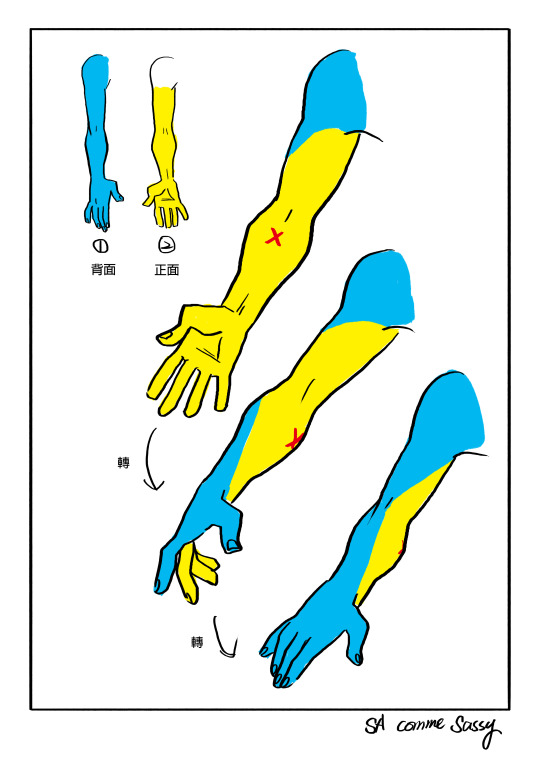
I’ve translated the ones that aren’t in English! (at least the ones in the main photoset, my Chinese isn’t good and I’m too tired from doing those translations to sit and decipher some of the characters that are blurry haha sorry)





 Aliquid de Magis